Newsletter No. 12 November 2026
Posted on November 20, 2026
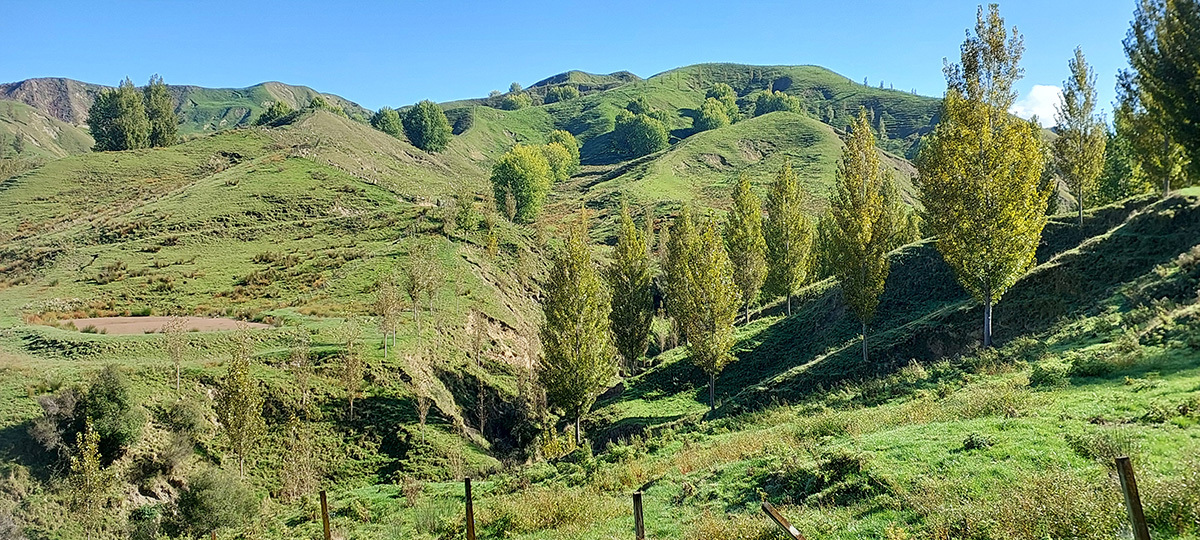
With a strong El Niño expected this summer, many farmers are preparing for the possibility of drier conditions, stronger winds and increased pressure on pasture and stock. While the impacts will vary across the country, it is a timely reminder of the value of having poplar and willow established in the right places on farm.
During challenging climatic conditions, poplars and willows help strengthen soils and reduce erosion risk, while also providing shade, shelter and fodder for livestock. In riparian area, they can help stabilise stream banks and protect waterways, whilst also provide habitat, while shading streams to help moderate water temperatures.
Well-established trees are a long-term investment in farm resilience, helping landowners manage the challenges of a variable climate.
As we head into summer, now is a good time to consider where strategic plantings could make a difference on farm, for the season ahead and for the longer term.
Trust visits Tairāwhiti
The NZPWRT Trustees recently travelled to Gisborne for their General and Annual General Meeting, taking the opportunity to spend a day visiting properties, research trials and nursery facilities across Tairāwhiti.
The visit was a chance to see how poplar and willow are helping protect vulnerable landscapes, hear from landowners taking a long-term view of their properties, and see how research continues to inform what we plant in the future.
Building resilience on-farm
The day began at Awapapa Station, where Alex Campbell, joined by Matt Long, shared the story of the Campbell family's long commitment to tree planting. With planting dating back to the 1970s, and a particularly strong poplar programme following Cyclone Bola in 1988, the property now has around 30% tree canopy alongside productive grazing.
The value of that investment was evident following Cyclone Gabrielle. Research found that trees at Awapapa were associated with a 71% reduction in slips when adjusted for farm size and slope. A visit to neighbouring Drumgoyle, with around 10 years of planting, showed how the same approach is being carried forward. It was a powerful reminder that trees are an investment in the long-term resilience of a farm. Without soil, it reduces the opportunity to keep farming successfully.
Making the most of every landscape
Matt Long also shared the thinking behind Glen Innis Station, recently purchased in partnership with Kate Long, Sam and Gemma Hain. The group is exploring how a largely pine-covered property could transition to a mix of productive grazing, strategically planted trees and areas of mānuka and native vegetation. Poplar and willow are among the options being considered for stabilising wetter country.
It is an example of matching land use to land capability, while looking for ways to balance productive farming with environmental outcomes.
The Trust also caught up with Fraser Briant, who shared the story of developing Mangaheia Station from a largely blank canvas. In order to achieve the planting of over 10,000 poles, Fraser had establishment of a number of pole nurseries in and around Gisborne.
For those without their own nurseries, the Gisborne District Council nursery at Waerenga-O-Kuri, supplies a variety of clones to the wider district. It was a valuable opportunity to see the nursery operation behind the trees that are being established across the region.
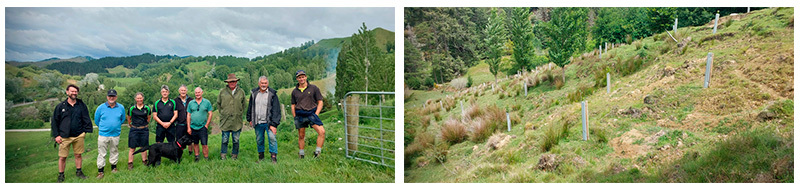
Left: Trustees Dan Harrison, Peter Kemp, Susan Kilsby, Grant Cooper and Stan Braaksma with Byrce McLoughlin (GDC), David Sharp (Chair - TAG) and farmers Alex Campbell and Matt Long at Awapapa. Right: rooted cutting trial planted 2026 at Eastwood Hill Arboretum.
Research with a long view
The Eastwood Hill Arboretum is host to two trials. One was planted in 1987 by Alan Wilkinson and contains Argyle, Dudley, Fraser, Otahauo, Selwyn and Tasman. The other was planted in winter 2026 with 20 clones, all rooted cuttings. These trials provide a great opportunity to look at the performance of different clones.
At Lavenham Road there is a Nelder trial, planted in 1994 with Kawa (Nelder trial is a way to assess how trees grow at different planting densities and spacings). In conjunction with this there is a space planted trial at 5x7 m spacing and 10x7 m spacings containing 5 different clones (see article below).
These long-running trials remain an important part of NZPWRT's work, helping maintain knowledge of established material and providing opportunities to observe how different cultivars perform over time.
The day finished at Kees Weytmans' property, looking at 10m pruned carbon plantings of poplar and trial sites.
Connecting research, people and practice
Across the day, one message came through clearly: effective erosion control and resilient landscapes are built through long-term commitment, sound research and practical action on the ground.
From decades-old trials to new plantings and innovative farm systems, the Tairāwhiti visit showcased the important connections between NZPWRT’s research, regional council priorities and the landowners putting the knowledge into practice.
With Tairāwhiti having experienced the devastating impacts of Cyclone Gabrielle, seeing the work being undertaken across the region reinforced the importance of continued investment in effective erosion control and resilient pastoral landscapes.
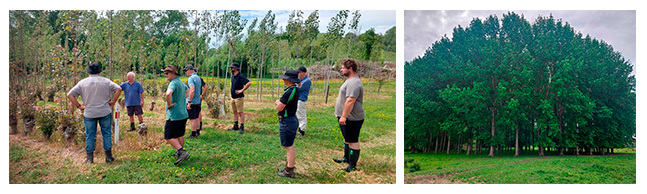
Left: Trustees visiting GDC nursery with Allan Hughes and Donte showing them around. Right: Lavenham Road, Nelder trial
Poplar as timber
Poplar has long played an important role in NZ’s hill country, primarily planted for soil conservation and erosion control. But could those same trees also represent an underutilised timber resource?
Kees Weytmanns, Forest Measurement NZ Ltd, undertook some measurements of existing space planted poplars in the Tairāwhiti involving 6 cultivars on 2 different sites and two different spacings (7x5 m and 7x10m) to determine the recoverable volume by log type. These spacing trials were established in 1994, making them 30.5 years old at time of assessment.
Kees used forest inventory and modelling tools to assess the volume of timber that could be recovered across different log grades.
Pakai at Lavenham Road recorded the highest estimated recoverable volume at 601 m3/ha, closely followed by Kawa at Whatatutu at 589 m3/ha. However, the research also highlighted important differences between sites and cultivars, reinforcing the need to understand how genetics, growing conditions and management influence timber potential.
Not all cultivars performed equally. Pakaraka experienced significant mortality at both sites, while Yeogi was affected by stem rot, reducing its timber quality and recoverable volume.
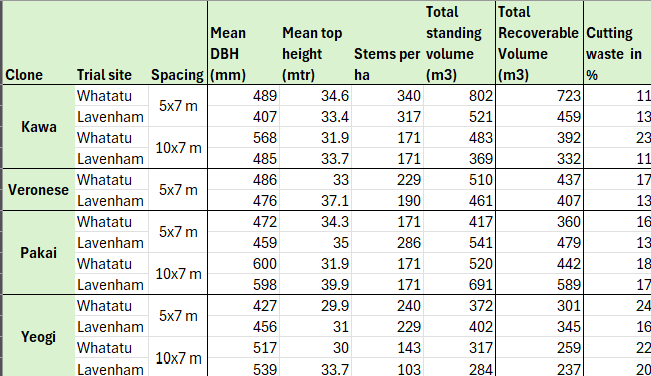
Examples of assessed timber volume from space planted trials in Tairāwhiti.
As a rough guide, Kawa between 8-24% (0-15%) P grade, 11-13% (8-15%) S grade, 18-24% (15-25%) A grade, 1-2% (15-25%) K grade, 17-18% (10-20%) KI grade, 21-30% (10-20%) KIS grade and 6-8% (10-20%) pulp. Pinus radiata log grade % are shown in brackets. This shows that grading of poplar is a close fit to an average pine forest.
The research is an important step towards recognising the value of New Zealand’s existing poplar resource. Much of the country’s mature poplar has been planted for land protection rather than timber production, yet there may be opportunities to generate additional value from these trees, especially if well managed (pruned), while continuing to deliver their soil conservation benefits.
Source: Kees Weytmans (2025), FGR-ST15, Establishing the Commercial Properties of Poplar Timber in New Zealand - PSP Assessments.
Willows: types, recognition and role
Ian McIvor
Willows are a familiar feature of New Zealand’s rural landscape, valued for their role in soil conservation, riverbank stabilisation, shade, shelter and stock fodder. But did you know that there are many different types of willows, each with different characteristics and uses?
Belonging to the genus Salix, willows include hundreds of species and hybrids worldwide. In New Zealand, they range from large tree willows commonly seen along rivers and hillslopes to smaller, multi-stemmed shrub and osier willows.
Choosing the right willow for the right location is essential. Most willows grow best in fertile soils with a reliable supply of moisture. They are particularly suited to river berms, lower hillslopes and areas where water naturally collects. They are generally less suitable for dry upper hillsides and exposed ridgelines, where summer moisture can be limited. Selecting cultivars suited to local soil and moisture conditions can make a real difference to establishment and performance.
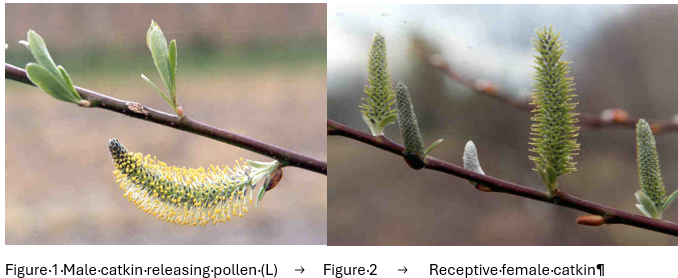
Willows also offer a range of practical uses beyond erosion control. Depending on the species or cultivar, they can provide shelter, shade and supplementary stock fodder, as well as material for basketry and potential bioenergy applications. Their flowering can also provide an important spring food source for bees, with different willows producing pollen over an extended period.
However, not all willows are suitable for planting. Crack willow and grey willow are two species to avoid, as they can spread and become problematic in waterways and wetlands. Crack willow can spread when brittle branches break off, travel downstream and take root, while female grey willows produce large quantities of seed. Careful selection of identified planting material is particularly important alongside waterways, where seed can be dispersed.
Understanding the differences between willow species and cultivars helps landowners, farmers and river managers make better planting decisions—supporting productive farms, more stable waterways and resilient landscapes.
Can willow stands help support native forest regeneration
Research highlights an unexpected ecological benefit of willow in riparian environments.
Willows are well recognised for their role in soil conservation, erosion control and riverbank stabilisation. However, research undertaken in Hawke's Bay has identified another potential benefit: naturalised willow stands may provide an environment that helps indigenous forest species regenerate.
A 2016 pilot study by Adam Forbes, published in Ecological Management & Restoration, investigated whether Bitter Willow (Salix elaeagnos) stands could support the establishment and growth of indigenous tree and shrub seedlings.
The study was undertaken along the Tukituki River in Central Hawke's Bay, where indigenous seeds were being dispersed into willow stands by fruit-eating birds from nearby native forest. The willow canopy provided shelter from the surrounding rank exotic grassland and a structure for birds to perch and deposit seeds.
Researchers wanted to establish whether opening small gaps in the willow canopy would allow more light through and encourage indigenous seedlings to grow.
Four individual willow trees were poisoned to create canopy gaps of approximately 5–6 metres in diameter. These were compared with three areas where the willow canopy remained intact. Seedling establishment and growth were monitored over three years.
The results were encouraging. Beneath the opened canopies, indigenous seedling densities increased from approximately 2,376 to 10,000 seedlings per hectare between 2012 and 2015. Seedling numbers beneath intact willow canopies changed very little over the same period. Seedlings beneath the opened canopies also showed greater height growth, with some progressing into taller height classes.
The findings suggest that Bitter Willow can perform a useful nurse role, providing an environment where indigenous seedlings can establish before eventually developing into a more diverse forest canopy. The willow also appears to provide a perch for seed-dispersing birds, helping bring indigenous seeds into the area.
What does this mean for willow management?
The research raises interesting possibilities for riparian restoration, particularly where naturalised willow stands are already established near indigenous forest remnants. Rather than viewing these stands solely as obstacles to restoration, there may be opportunities to manage them in ways that encourage native regeneration.
This was a pilot study and that further research is required to understand how different willow species, canopy gap sizes and the timing of canopy opening influence regeneration outcomes.
This research is a useful reminder that poplar and willow can provide ecosystem services beyond their traditional role in erosion control. Understanding how these trees interact with their surrounding environment can help inform more integrated approaches to riparian management and landscape restoration.
Research reference: Forbes, A. (2016). Canopy manipulations of exotic Bitter Willow (Salix elaeagnos) forest for indigenous seedling recruitment: A pilot study. Ecological Management & Restoration, 18(1).
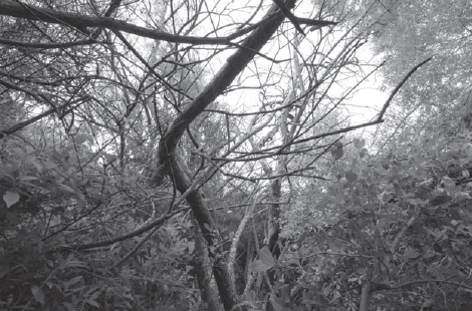
Example of the experimental canopy-opening treatment effected by poisoning a single Bitter Willow (Salix elaeagnos) among an otherwise continuous canopy.
What tree is that?
So there is an established tree. You know that it is a poplar, but what clone? Explorer can help you identify what it is. Download the QR code below into Survey 123 (the experience is better if you download Survey 123 first. NOTE you do not need an account).
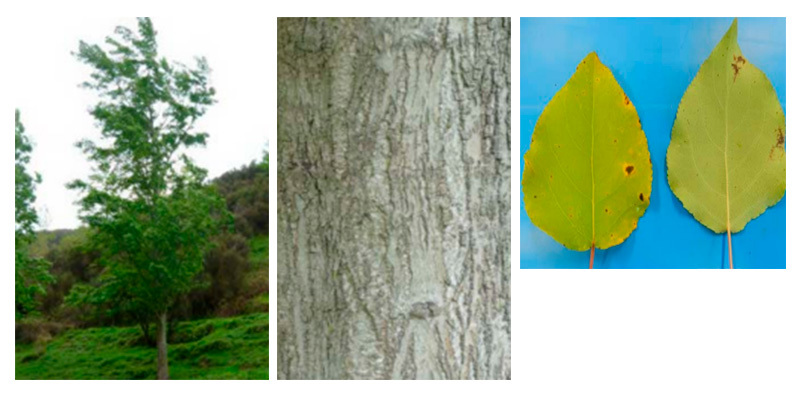
Using Explorer work your way through the photos and information below to decide what tree is in the pictures.

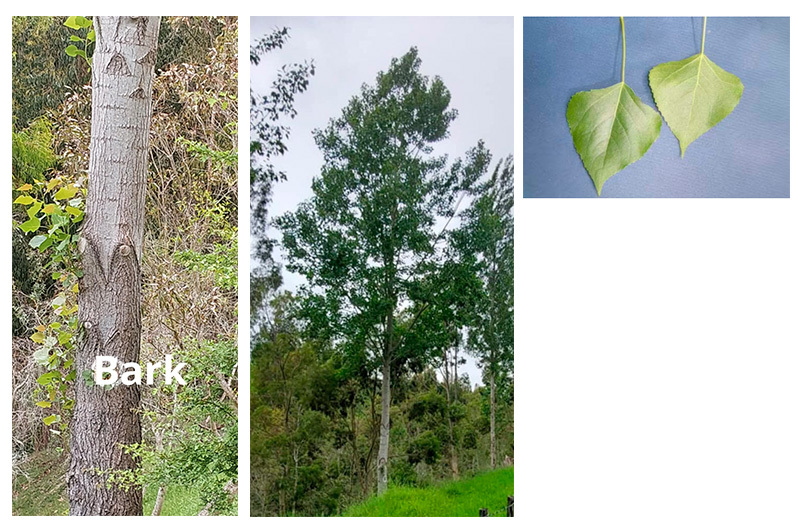
As you work through the App, the first section asks you several questions about form and bark characteristics. If you have answered all the questions correctly in this section, it should show up with the result. This is not the case for all and you will need to continue to enter information. If nothing comes up, we recommend you take photos of the form, bark and leaves and send your report through to info@poplarandwillow.org.nz and we can help you identify.
Showcasing … Geyles (poplar)
‘Geyles’ (Populus maximowiczii x P. nigra) is a male poplar clone.
It is a narrow crown tree, with excellent apical dominance, and generally light branching. It has a fluted trunk and smooth bark, that create scallop patterns as it matures. The smooth bark can make it more susceptible to bark stripping by cattle and deer. Branching angle is moderate.
‘Geyles’ leaves are round, moderate in size that are green on top and grey-green underneath with a pink petiole. The leaf edge is finely serrated and wavy. ‘Geyles’ is rust resistant, wind and frost tolerant but avoid coastal environments.
‘Geyles’ is well suited for soil conservation. Performs best in the west.
Coming up …
Workshops
Several workshops are being planned.
- Bio-engineering River Management 16-17 February, Christchurch
More information on Resilient Rivers website or register by contacting rachael.armstrong@teurukahika.govt.nz - Train the Trainer workshops, sponsored by Te Uru Rākau - workshops are planned for:
- Northland 8-9 December at Whangarei Register here
- Horizons 2-3 March at Taumarunui Register here
Note: The tree you found in Explorer should have been Otahuao